

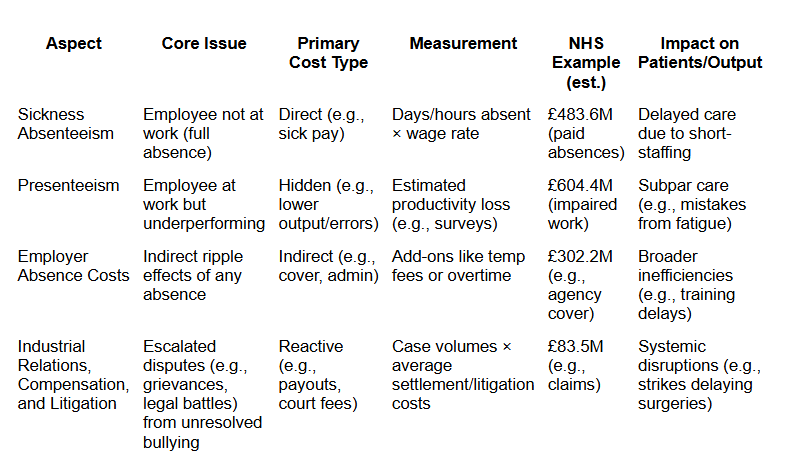
“Peer-to-peer bullying”, “horizontal violence”, or “lateral aggression” as it is called in NHS nursing costs the health service an estimated £2.281 billion annually, according to a 2019 study by Roger Kline and Duncan Lewis in Public Money & Management. This conservative figure includes:
Sickness absenteeism: £483.6 million
Employer absence costs: £302.2 million
Employee turnover: £231.9 million
Productivity losses: £575.7 million
Sickness presenteeism: £604.4 million
Industrial relations, compensation, and litigation: £83.5 million
The Financial Toll of Bullying
Here’s a breakdown of the key aspects:
Compounding Costs: Litigation and Patient Harm
In October 2025, British health leaders warned of potential cuts to jobs and services in the NHS unless an extra £3 billion was found to cover unbudgeted costs, such as those those from bullying and litigation. The £2.281 billion annual toll from bullying is bad enough, but compounding patient litigation pushes it over the edge: maternity-related provisions alone contribute massively to total liabilities of £60 billion as of October 2025, with potential maternity costs since 2019 estimated at £27.4 billion in England. Kline and Lewis note that bullying deters staff from speaking up, admitting or challenging mistakes, and harms team work, directly harming patient outcomes. Maternity cases represent 41-53% of total NHS negligence payments despite only 11-13% of the caseload. Most major NHS scandals centre on maternity ward breaches of “first do no harm,” yet interventions never employ evolutionary psychology insights. Why?
A Long-Recognised Problem
NHS England has long noted the problem: a 1999 study called bullying a “serious problem” in trusts; a 2024 report quotes nurses calling the phenomenon “eating our young.” I used to work in the NHS: maternity services were talked about as the worst for bullying. This is one of those rare cases where the anecdotal evidence matches the empirical
The Pink Elephant in the Feminist Room
As readers of this blog know, I’ve long argued that female intrasexual competition is the pink elephant in the feminist room, and that feminism itself shows zero duty of care towards women—only towards feminists. As Dr Dani Sulikowski noted in our interview, evil intentions can easily be wrapped in prosocial platitudes, and hashtags such as #MeToo; #TransRightsAreWomensRights; and the ironic #ReproductiveRights. I say ironic, because when it comes to abortion, it seems (to paraphrase the prayer of Saint Michael), that feminists more resemble demons who prowl the world seeking the ruin of women’s souls.
The pink elephant in the feminist room is the subtle, status-seeking sabotage women inflict on each other, from boardrooms to wards, all while waving solidarity flags. It’s not “catty” chaos; it’s evolutionary wiring turning potential allies into unwitting adversaries. Feminism itself bears no duty of care toward women, only toward other feminists. I have detailed the empirics of this numerous times here, here, and here (and many more). Feminism champions the elite vanguard (and flatters those who toe the ideological line) while we lumpenfrau pay the price in silenced voices, shattered trust and ruined careers.
Female Intrasexual Competition in a Female-Dominated Workplace
Nursing, being a majority-female environment (90% of nurses are women), is a perfect laboratory for female intrasexual competition. A 2019 meta-study identifies classic strategies: gossiping, exclusion, hostility, invasion of privacy, with predictable outcomes like sadness, depression, burnout, and 10% developing PTSD. Narrative studies show this culture is entrenched in training, where trainees are expected to become encultured to it. Surveys of 1.3 million NHS staff show 23% experiencing bullying—peer-to-peer tactics like exclusion or undermining that start in training and deter reporting errors or collaboration, directly affecting patient safety.
Ideology Meets Bullying: The Natural Birth Crusade in Maternity
Victim payouts layer on financial strain: NHS maternity negligence claims hit £1.15 billion in 2023-24 (41% of all clinical negligence liabilities), pushing overall provisions to £60 billion by October 2025. Annual cash payments for negligence have quadrupled over 17 years to £2.8 billion, with maternity surges driving settling costs from £1.1 billion (2006-07) to £3.6 billion (2024-25).
We now see it in the NHS’s “horizontal aggression” hellscapes, where feminist midwives endanger their charges. In maternity units (also ~90% female staff), bullying intersects with the ideological push for “natural births” rooted in the Active Birth Movement founded by Janet Balaskas in the 1980s. Promoted through the Active Birth Centre, it emphasises women as “active birth givers” controlling their bodies without interventions like C-sections—emerging from “a feminist well,” as Balaskas said in a 2023 interview. This is a feminist triumph on paper, but it is actually a Trojan horse of antagonism toward “patriarchal” medicine, where evidence-based care gets branded as oppression, and dangers to women are romanticised away. The Royal College of Midwives incorporates Active Birth modules; the Centre offers hypnobirthing with no mention of related scandals.
Catastrophic Failures: The Maternity Scandals
This ideology directly contributed to catastrophic failures:
Shrewsbury and Telford (Ockenden Review 2022): 300 babies died or were brain-damaged, 12 mothers died (2000-2019). Low C-section rates—praised under RCM “Wait and See” campaigns—delayed surgery; a “culture of institutionalised bullying” silenced whistle-blowers for decades.
Nottingham, Morecambe Bay (Kirkup investigations), East Kent, and others: Toxic cover-up cultures, staff intimidation, conflicts between natural-birth midwives and surgeons recommending C-sections. Ockenden criticised the NHS’s “obsession with normal births.”
Towards Solutions – Or Missing the Root Cause?
Health Secretary Wes Streeting launched a national maternity inquiry in June 2025 (covering 14 trusts, due December) into “systemic failures.” Kline and Lewis recommend better capture of incivilities and bystander interventions. Ockenden calls for guaranteed C-section access, barring negligent staff, and cultural audits. The issue of evolved strategies of female intrasexual competition amplified by a toxic feminist ideology has not yet made it to the consulting room. It should. It could save billions of pounds and countless lives.
References
Kline, R., & Lewis, D. (2019). “The price of fear: Estimating the financial cost of bullying and harassment to the NHS in England.” Public Money & Management, 39(3), 166–174. https://doi.org/10.1080/09540962.2018.1535044
Ockenden, D. (2022). Final report of the Ockenden review: Independent investigation of maternity services at Shrewsbury and Telford Hospital NHS Trust. UK Government. https://www.gov.uk/government/publications/final-report-of-the-ockenden-review
Kirkup, B. (2015). The report of the Morecambe Bay Investigation. UK Government. https://www.gov.uk/government/publications/morecambe-bay-investigation-report
Kirkup, B. (2022). The report of the independent investigation into maternity services at East Kent Hospitals University NHS Foundation Trust. UK Government. https://www.gov.uk/government/publications/the-report-of-the-independent-investigation-into-east-kent-maternity-services
NHS Resolution. (2024). Annual report and accounts 2023/24. https://resolution.nhs.uk/services/reports-and-accounts/
UK Government. (2025, June 23). “National maternity investigation launched to drive improvements.” https://www.gov.uk/government/news/national-maternity-investigation-launched-to-drive-improvements
Active Birth Centre. (n.d.). Homepage.
https://www.activebirthcentre.com/
Raafat, N. (2023, March). “Janet Balaskas interview: The mother of active birth.” Nadia Raafat. https://nadiaraafat.com/janet-balaskas-interview/
The Guardian. (2025, October 17). “NHS medical negligence liabilities hit £60bn amid surge in maternity payouts.” https://www.theguardian.com/society/2025/oct/17/nhs-medical-negligence-liabilities-hit-60bn-amid-surge-in-maternity-payouts
Birthrights. (2025, July 24). “The cost of a broken maternity care system: NHS facing £27bn bill for maternity negligence claims.” https://birthrights.org.uk/2025/07/24/the-cost-of-a-broken-maternity-care-system-nhs-facing-27bn-bill-for-maternity-negligence-claims/
The Guardian. (2025, May 14). “NHS medical negligence liabilities hit £58.2bn amid calls to improve patient safety.” https://www.theguardian.com/society/2025/may/14/nhs-medical-negligence-liabilities-hit-582bn-amid-calls-to-improve-patient-safety
How Much Compensation? (2025). “How Much Compensation For NHS Negligence?” https://www.howmuchcompensation.co.uk/how-much-compensation-for-nhs-negligence
BMJ. (2025, October 20). “NHS medical negligence costs reach £60bn as maternity payouts soar.” https://www.bmj.com/content/391/bmj.r2211
“I’ve long argued that female intrasexual competition is the pink elephant in the feminist room, and that feminism itself shows zero duty of care towards women—only towards feminists.”
EXACTLY right. It’s a mistake to believe that feminism cares about women. Like all ideologies, its first priority is its own empowerment and growth.
https://jmpolemic.substack.com/p/feminism-as-entitlement-pt-5
Your welcome, keep up the good work. More women need to speak up and bring the inconsistencies and ideological BS to peoples attention and call it out for themselves. Especially where it concerns natal subject, which after all is a core aspect of female and by extension human nature and existence. No women, no children, no children, no humans. Of course the Chinese are developing artificial wombs, due to demographic collapse caused by the malignant insanity of socialism and the years of antinatal, anti-human policies, all socialists fetishise.